
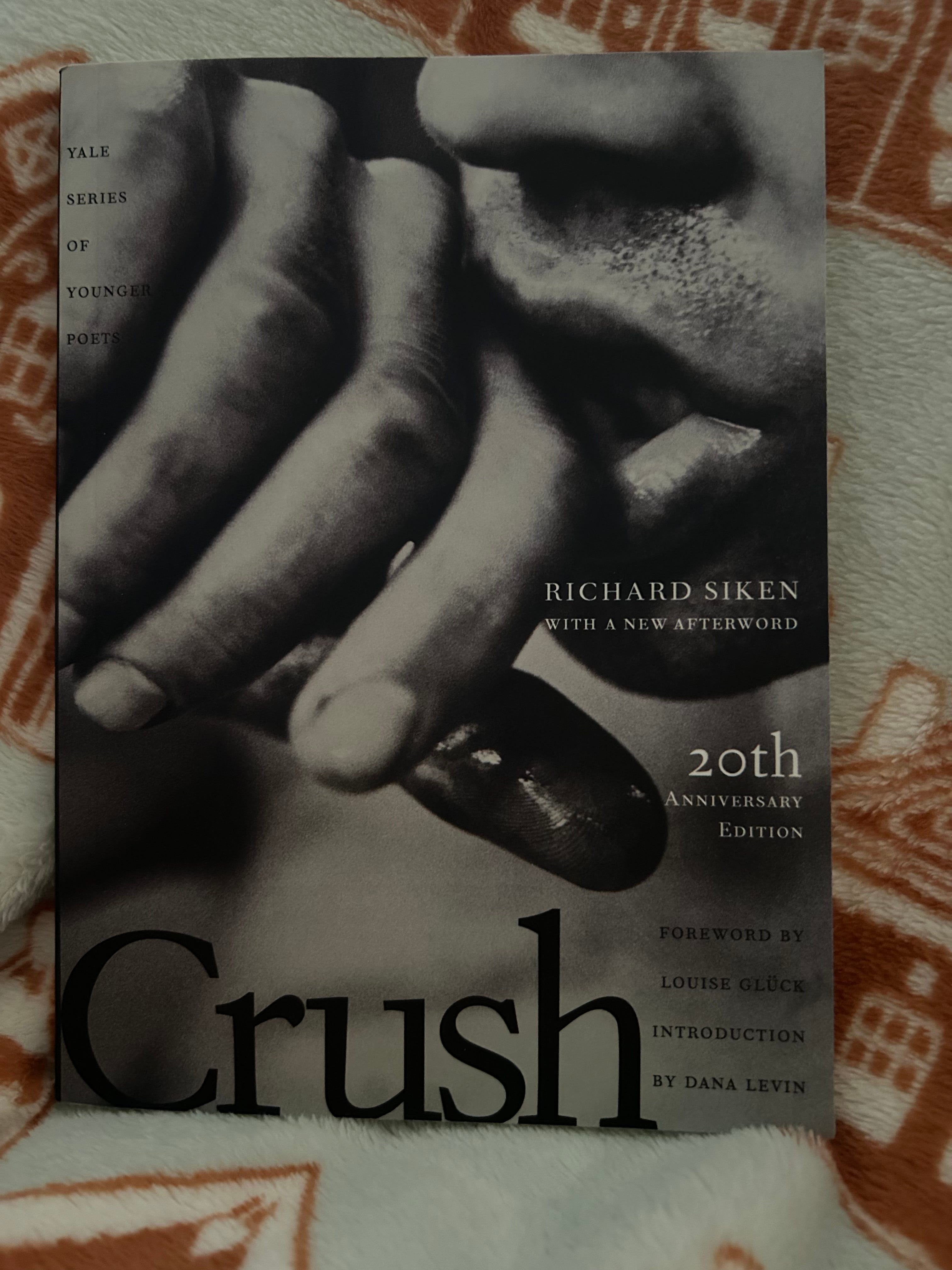
Triangulating Coordinates to "The Dislocated Room" by Richard Siken
Close Reading #5

[CW: Sexual Content, Violence, Blood]
As noted in previous close reading posts of mine, I rooted this practice in a post by Tinderbox Poetry Journal’s Substack on using close reading as a tool for my own writing. You can check out their guidance in the post below:

If you’d like to check out prior close readings, click the buttons below:
I: The Poems I Almost Chose and What I Liked About Them
Much like I did last week, I went through each section and picked out a favorite. Siken’s classic has three parts, labeled with Roman Numerals I, II, and III. The dislocated room we’ll be triangulating (triaging???) the coordinates for later on is in part three, so I’ll share my thoughts on my favorites from parts I and II:
I “The Torn-Up Road:” The imagery here is so visceral it makes me forgive the first line, “There is no way to make this story interesting,” (Siken, 9). One might feel “smothered,” “pressed,” “covered,” maybe even “crushed” (hehe) under all of the love and loathing and panic after reading this poem.
II “A Primer for the Small Weird Loves:” Sean Bates featured a section of this poem in his much more in-depth review of this seminal collection, and in context it still holds up. Echoing what Sean wrote, the pronoun fuckery here is such a crafty way to turn the seemingly confessional presentation of this poem on its head and force the reader to contend with their own voyeuristic relationship with the work itself.
While I really liked, “The Torn-Up Road,” and, “A Primer for the Small Weird Loves,” the poem that stuck with me the most was “The Dislocated Room,” found in section III. The sheer amount and intensity of imagery in this piece bore its way into my brain, a “shining star buried deep inside,” (49) me, if you will.
II: Locating Imagery in “The Dislocated Room”
Now, when I think imagery, I usually jump right up to grab at the visual images that I conjure while reading. While, yes, there is captivating visual imagery that I want to highlight, there’s also other types that I want to delve into. Consider, for example, the following instance of auditory imagery:
I thought I heard the clink
     of ice to teeth. I thought I heard the clink of teeth to glass.
(47)
I like this auditory imagery in particular because it hearkens back to an earlier poem in the collection where he mentions chewing ice like it’s broken glass. That imagery’s just clinking around in my head before it can melt, thanks.
In addition to auditory imagery, I also picked up on some enthralling bits of tactile and kinetic imagery throughout:
the heat escaping like a broken promise.
(46)

some sort of shining star now buried deep inside you and he has to
                                           dig it out with a knife.
(47)

Left hand raising the fork to the mouth, feeling the meat slide down
    your throat, thinking
(48)

     I've been in your body and it was a carnival ride.
(48)

     Cut me open and the light streams out.
Stitch me up and the light keeps streaming out between
                                                      the stitches.
(48)

Digging out the bullet and holding it up to the light.
(49)
I also notice here that especially with the tactile imagery, there’s this mixing of senses that paints more depth to the scenes unfurling before me. Speaking of painting, the visual imagery here is top-notch. The following bits were some of my favorite visuals in the whole collection:
                                                 but a Holiday Inn,
with bougainvillea growing through the chain link by the pool.
(46)
I adored the image of bougainvillea growing through a fence near a pool at a Holiday Inn. It’s sacred and profane at the same time. It’s vibrant life poking through the dull concrete of a cheap hotel in some part of this god-forsaken country hot enough for the flowers to thrive in neglect. It’s giving the much later (and brattier) lyric “Jesus Christ on a plastic sign,” from “Everything is Romantic” by charli xcx. But let not the fence impede us before we dip into the waters of a few more pieces of my favorite visual imagery, eh?
It was night for many miles and then the real stars in the purple sky,
   like little boats rowed out too far,
begin to disappear.

(46)

You can see the shadow that the man is throwing across
    the linoleum,
how it resembles a boat, how it crosses the tiles just so,
              the masts of his arms rasping against the windows.
(47)
These boat images pair so well with the car motifs in this poem as well as a lot of poems throughout this collection. In addition, these parts link to the liquid in the bloody sink and pool also mentioned in this piece. The images flow together into a current of—well, I’m not gonna’ tell y’all, ‘cause I promised I wouldn’t get into meaning land for these close reading exercises, didn’t I? Y’all will just have to read it for yourselves if y’all haven’t already. In any case, whatever these images mean, I feel changed for having pictured them in my little noggin, and I hope y’all do, too.
Thank y’all for joining me on this close reading of “The Dislocated Room” from the 20th anniversary edition of Richard Siken’s Crush. Shout out again to Sean for his much more in-depth review of Crush, which touches on some of the other reasons why this collection is a modern classic:
